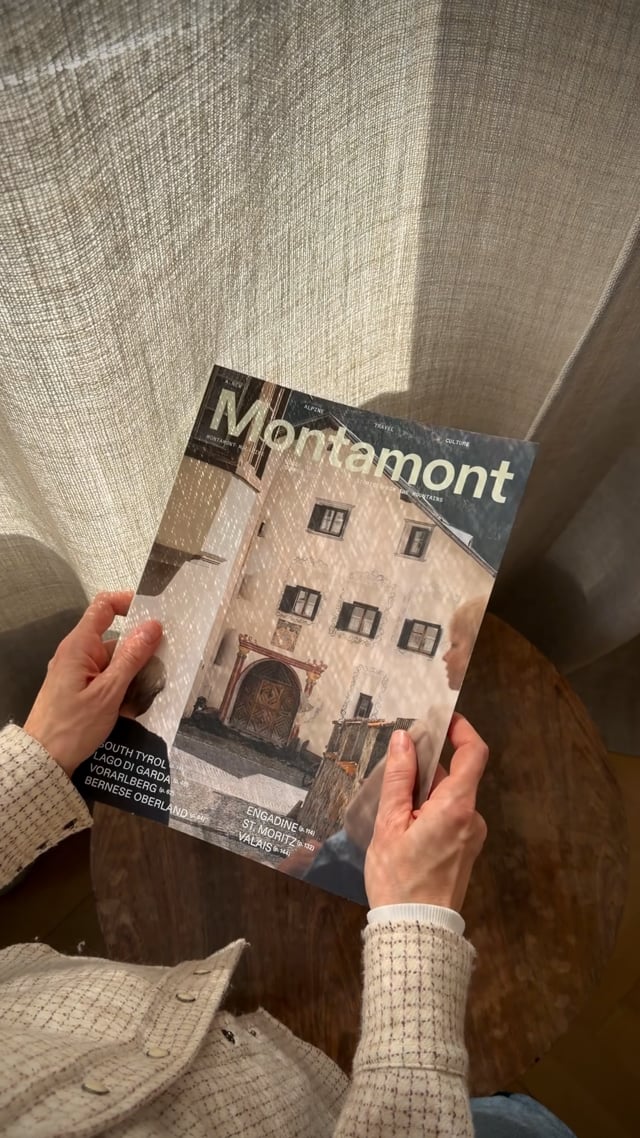
IWC Schaffhausen
Holding Time
Words: Isabella Rabensteiner;
Photography: Mike Rabensteiner (Montamont)
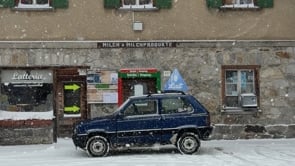
We are on the road with IWC Schaffhausen. The latest Ingenieurs on the wrist, not yet released. Gérald Genta designed the original in 1976 – five screws on the bezel. The steel bracelet feels soft, almost warm. The dial as clear as the mountain air. We bring them somewhere they belong. To places we already love, familiar faces, old favourites, and a few new ones along the way. From Sils Maria, in an electric blue Fiat Panda, we drive into swirling snowflakes on the Maloja Pass. Cheese from the Latteria in a paper bag on the back seat. Down into the Bergell, towards Soglio, where spring is finally waiting for us. These are places shaped by a particular light. The kind that has drawn artists here for a long time. It hasn’t stopped.


Chapter I
The Waldhaus sits above Sils Maria the way a sentence sits above its footnotes. With authority, and without effort. It opened in 1908, and five generations of the same family have run it since.
What captures it is the man in the bathrobe walking past the porter, skis on his shoulder, heading for the car. The children doing homework in the library before the mountain claims them for the afternoon. The wallpaper – golden. The stucco above, and the light through the window.
Outside: April. A wall of snow moves past the glass like a slow curtain. Inside: warm, unhurried, entirely its own era. Artists, writers, intellectuals, they’ve been coming here for over a century. All movement and life. The Waldhaus holds more than one era at a time. That is precisely the point.


Chapter II
Andrea Klainguti was waiting in front of the Waldhaus. Next to the big cars, his Panda. And everyone looked at the Panda.
The original, the real one. Designed by Giorgetto Giugiaro and unveiled at the 1980 Geneva Motor Show as something almost defiantly simple. There’s a directness to it that mirrors something in the Ingenieur’s DNA. Two designs from the same decade. In St. Moritz, the Panda is a cult object. It parks in front of grand hotels with the same ease it handles a mountain pass in a snowstorm. Reliably, goes like a Swiss watch.
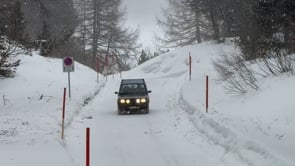
Andrea drove us along the lakes as the Engadin dissolved into white. Full white-out, fingers going numb, windows still open. Engadine spring vibes.






Chapter III
The Pontisella is a patrician house from an era when buildings were built to last centuries, and it shows – in the wooden doors that open onto nothing, relics of floors that no longer exist. In the ceiling paintings whose colours have not dimmed. In the kitchen with the open fire where guests sit at the long table for breakfast and talk about art before the day pulls them outside.
Daniel composes the scene. Design epochs coexist in every shelf, every corner, every table arranged. You walk in and feel, immediately, that someone with a rare kind of eye has been at work here.
The watch does not interrupt this. It becomes part of it. A design that also carries time within it, without belonging to just one moment.
After breakfast, we followed the sun through the streets of Stampa. This is Giacometti country. Alberto grew up here, worked here, his studio still stands. In these streets the watches on our wrists were the only thing counting.


Chapter IV
You descend from the Maloja, lose altitude through the Bergell, then climb again. And then it appears. This village, the Sciora group across the valley, the chestnut groves beginning their descent below the walls. The snow of the morning feels like another country.
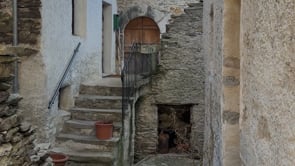
The air here is different. Warmer, yes, but also stiller. The mossy stones, the gnarled wood, the narrow lanes where afternoon light falls against old walls. Everything here has the texture of something that has stood long enough to stop caring whether it’s beautiful or not, and become beautiful for exactly that reason.
We walked above the village. Around us: silence, except for the soft ticking of the watch. The only witness that time had not, in fact, stopped.


That is perhaps what connects all of this: the Ingenieur, built for any condition, any altitude, engineered for the raw end of things. The architecture of these mountains, built to last and shaped by everything the altitude demands. Functional, reduced, without ornament that doesn’t earn its keep.
Holding Time is not a metaphor. It is what good design actually does. These places hold time. These objects hold time. And for a few days in April, so did we.

Montamont travelled through the Engadin and Bergell with IWC Schaffhausen, wearing the new Ingenieur collection ahead of its release.